
Long before leaving cookies and milk out became a familiar holiday tradition, people across Europe were setting aside food for very different visitors. Bowls of milk, cream, porridge, and other small offerings were sometimes left near the hearth or around the home for spirits that were believed to share the household.
These weren’t always distant supernatural beings hiding deep in the forest or lurking at cemeteries or abandoned places. Household spirits belonged much closer to home. Folklore placed them beside the stove, in the barn, near the fireplace, and in the quiet corners of everyday domestic life. Depending on the tradition, they might protect the family, care for livestock, or even complete chores while everyone slept. In return, the household was expected to treat them with respect.
Food played an important role in many of these stories. Scotland had tales of helpful brownies and offerings of cream or milk. Scandinavian folklore warned farmers not to forget the nisse and his bowl of porridge, especially at Christmas. In Slavic traditions, the domovoi was closely tied to the home and the family living within it.
Of course, these spirits weren’t always sweet little helpers. Folklore is filled with stories of household guardians becoming irritated, mischievous, or outright frightening when they were insulted or neglected. Leaving something by the fire wasn’t necessarily an act of worship. Sometimes, it was simply a way of staying on good terms with the unseen member of the household.
So, why did people feed spirits they couldn’t see? And why do milk, cream, and porridge appear so often in stories of the supernatural home?
To answer that, we have to look at a time when a house was believed to shelter more than just the people who lived inside it.

The Home Was Never Truly Empty.
Today, when we think of folklore, our minds tend to wander toward haunted forests, ruined castles, and creatures hiding somewhere far beyond the safety of home. But for much of history, the supernatural was not always believed to exist at such a comfortable distance. Sometimes, it lived under the same roof.
Stories of household spirits appear throughout European folklore, although their names, personalities, and traditions vary greatly from place to place. Scotland had the brownie, Scandinavia had the nisse and tomte, and Slavic folklore told of the domovoi. These were not simply different names for the same creature. Each belonged to its own cultural tradition, but they shared a familiar role: a supernatural presence closely tied to the home, farm, or family.
It is easy to understand why the home became such fertile ground for folklore. For families whose lives depended on a successful farm, healthy livestock, stored food, and a warm fire, small problems could have serious consequences. An animal becoming restless in the night, food disappearing, or unexplained noises beneath the floorboards all left room for stories about an unseen resident of the household.
Many of these spirits were believed to be helpful when treated well. They might complete chores, protect animals, or contribute to the prosperity of the home. The Scottish brownie was especially known for performing household and farm work at night, while the Scandinavian nisse was closely associated with the farmstead and the care of its animals.
The relationship, however, came with expectations. Household spirits in folklore were often remarkably easy to offend. A family might never see the being believed to share their home, but that did not mean they could ignore it.
And so, in stories and traditions passed down across generations, people left something behind.
A bowl of cream. A little milk. A serving of porridge.
Not for a guest they expected to arrive at the door, but for the one who was already inside.
The Brownie at the Hearth.

In Scottish folklore, few household spirits are as closely associated with domestic life as the brownie. Far removed from the chocolate dessert that now shares its name, the brownie was described as a shaggy, solitary spirit that attached itself to a particular home or farm. During the day, it remained hidden. At night, while the household slept, it was said to get to work.
The chores attributed to brownies were hardly magical in the glamorous sense. They threshed grain, tended to farm work, and completed the tiring jobs that had been left unfinished at the end of the day. Older Scottish folklore collections describe them as secretive helpers who worked only when no one was watching. A family might never actually see the brownie believed to live among them; they simply woke to find that work had somehow been done.
In many brownie traditions, food appears as part of the relationship between the spirit and the household. Milk, cream, porridge, and small cakes are all associated with offerings left where the brownie could find them. Scottish folklore even records a place known as a “Brownie’s Stone,” where cow’s milk was reportedly offered each Sunday.
Brownies were also famously sensitive creatures. Folklore repeatedly tells of them abandoning homes after being offended by the people they had helped, sometimes over gestures that were seemingly meant as acts of gratitude. The message in these stories is surprisingly consistent: a brownie might work tirelessly for a household, but it did so on its own terms.
Perhaps that is what makes the tradition so interesting. The bowl left behind was not simply bait for a supernatural visitor. It was part of a relationship with a being believed to already belong to the household. Feed it, respect it, and allow it its privacy.
Most importantly, never make the mistake of assuming it works for you.
The brownie may have completed the household’s chores, but folklore rarely treated its help as something a family could control. Stories repeatedly warn that these spirits were easily offended, and even a well-intentioned gesture could drive one away. Clothing was particularly dangerous. In several brownie tales, a family leaves new clothes for the spirit in gratitude for its work, only for the brownie to put them on and disappear for good.
Why clothing had this effect is less clear. Some stories suggest the brownie was insulted by the gift, while others simply repeat the strange rule without explanation. Whatever the reason, the lesson remained the same: a brownie helped on its own terms, and the people sharing its home were better off respecting the traditions surrounding it.
The brownie was helpful, but never entirely predictable. It worked unseen, followed rules that the household might not fully understand, and could leave when those rules were broken. Perhaps that is why the image of a bowl left behind feels so fitting. It required no invitation and demanded no appearance from the spirit itself.
You simply left something behind and hoped that, by morning, the brownie was still on your side.
A Bowl of Porridge for the Nisse.

If the brownie preferred to work quietly and remain unseen, the household spirits of Scandinavian folklore could be considerably more demanding.
Known as the nisse in Norway and Denmark and the tomte in Sweden, this small supernatural figure was closely tied to the farmstead. He was believed to watch over the property and its animals, particularly the livestock kept in the barn. Like the brownie, a helpful nisse could be an enormous benefit to the people living there. An offended one was another matter entirely.
One of the most enduring traditions surrounding the nisse was the bowl of porridge left for him at Christmas. The exact customs and names varied across Scandinavia, but porridge appears again and again in the folklore surrounding these farm spirits. In many stories, simply remembering the bowl was not enough. The nisse expected it to be prepared properly, and butter was particularly important.
One folktale makes this very clear.
A farmer’s nisse received his porridge and discovered that there was no butter on top. Furious at what he believed was an insult, the spirit went into the barn and killed one of the farmer’s cows. Only later, when he returned to finish his meal, did he discover the butter hidden at the bottom of the bowl.
The nisse had made a terrible mistake.
According to the tale, he then went searching for another cow that looked exactly like the one he had killed and brought it back to replace the farmer’s animal. It is a strangely dramatic response to a misplaced pat of butter, but it captures the nisse’s personality remarkably well. These spirits could be hardworking and fiercely protective of a farm, yet folklore also portrayed them as quick-tempered and capable of causing real harm when they believed they had been mistreated.
The Christmas porridge was therefore more than a charming seasonal treat. Within the folklore, it was part of maintaining a good relationship with the unseen guardian of the farm. Forgetting the nisse, stealing his food, or serving it incorrectly could have consequences far greater than an untouched bowl in the morning.
Over time, the nisse became increasingly connected with Christmas, eventually developing into the familiar red-capped figure seen throughout Scandinavian holiday traditions today. But beneath the cheerful decorations and tiny bearded figures is an older version of the spirit: one who watched the barn, cared for the animals, and expected his porridge to be waiting.
Preferably with the butter somewhere he could see it.
The Spirit Who Moved With the Family.

In Slavic folklore, the domovoi was more than a creature hiding in a forgotten corner of the house. It was a guardian of the household itself, closely connected to the family, their animals, and the everyday life unfolding beneath the roof.
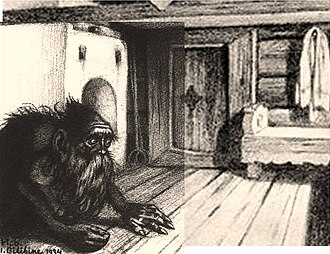
Descriptions of the domovoi vary across Slavic traditions, but it was often imagined as a small, hairy old man or as a figure resembling the head of the household or a deceased family member. In many stories, however, the spirit was rarely seen at all. Its presence was known through sounds: creaking walls, unexplained knocks, or noises heard in the house at night.
Like the brownie and the nisse, the domovoi could be protective when the household remained in its favor. It watched over the home and livestock and, in some traditions, was believed to warn the family of approaching trouble. Strange sounds or changes in its behavior might be interpreted as an omen, turning the unseen spirit into something of a supernatural observer of the family’s fortune.
Food once again played a role in maintaining this relationship. Folklore and later collections of Russian folk belief record offerings of supper, milk, bread, sugar, and bread with salt. The food could be left for the domovoi as a way of acknowledging the spirit believed to share the household.
But perhaps the most fascinating traditions surrounding the domovoi appeared when a family decided to leave their home.
Moving did not always mean abandoning the household spirit behind. Rituals were recorded in which the domovoi was specifically invited to follow the family to a new house. In some traditions, it was coaxed to come along and welcomed into the new home, preserving the relationship between the spirit and the people it had guarded.
This small detail changes the way we might imagine a house spirit. The domovoi did not necessarily belong to old floorboards, a particular stove, or a single roof forever. Its connection could be to the family living there.
The house might be left behind.
The spirit, if properly invited, came with you.
Perhaps this is why feeding a household spirit was about more than keeping a mysterious creature satisfied. In the case of the domovoi, the offering acknowledged a presence woven into the life of the family itself. It watched the home, shared its spaces, and, according to folklore, might even pack up and follow when it was time to begin again somewhere new.
Why Milk, Cream, and Porridge?
After meeting the brownie, the nisse, and the domovoi, a pattern begins to emerge. These spirits came from different cultures and belonged to different traditions, yet food repeatedly appears in the stories told about them.
Milk and cream are especially common in brownie folklore, while the nisse became famous for his bowl of porridge. Bread, cakes, and portions of the household’s supper also appear in traditions surrounding household spirits. The exact offering changed from place to place, but the food itself was usually familiar. These were not rare ingredients gathered for an elaborate supernatural ritual. They were foods already found in the home and on the farm.
It is tempting to search for one symbolic explanation for why milk appears so often. Modern retellings frequently describe it as a symbol of purity, fertility, or abundance, but historical folklore is rarely kind enough to give us such a simple answer. The surviving stories and collections tell us that milk and cream were offered, but they do not always explain why.
What they do reveal is just how important dairy was to everyday rural life. Milk was not limited to the glass or bowl. It could become cream, butter, and cheese, making a healthy cow and a successful supply of milk valuable to the household. Scottish folklore is filled with anxieties surrounding dairy production, including beliefs that witches or fairies could steal milk or somehow prevent it from producing cream, butter, or cheese.
Against that background, leaving milk or cream for a supernatural presence takes on a little more weight. Perhaps the value was not hidden in a single magical meaning, but in the simple fact that the household was sharing something useful from its own stores. The same can be said for porridge, bread, and cakes. These were foods connected to the daily life of the people telling the stories.
There is also something fitting about feeding a household spirit with household food. The brownie worked around the farm. The nisse watched the barn and livestock. The domovoi belonged to the life of the family. Their offerings came from the same kitchens, animals, and stores they were believed to protect.
The food left behind was ordinary.
The intended guest was anything but.

When the House Spirit Wasn’t Happy.
So far, the house spirits in these stories have been surprisingly useful. They finish chores, watch over animals, guard the home, and occasionally follow the family to a new one. It almost makes leaving a bowl of porridge or a little milk seem like a very good bargain.
The problem was that household spirits were not always easy to please.
Across these traditions, stories repeatedly warn of what could happen when a spirit felt insulted, neglected, or mistreated. The consequences varied from one tale to another, but the helpful presence in the home could quickly become a source of mischief or fear.
Brownies were known to punish lazy servants and create trouble around the household. Some stories describe pinching, broken or overturned objects, and noisy disturbances at night. A brownie that felt truly insulted might simply leave, taking its help with it. In more extreme tales, an angered brownie could become far more destructive.
The nisse was no less temperamental. Folklore blamed an offended nisse for overturned milk buckets, spoiled cream, broken harnesses, and trouble in the barn. Considering how closely the spirit was connected to the farm and its animals, its anger could strike directly at the parts of rural life a household depended upon.
Even the protective domovoi had to be appeased when angered. Traditions surrounding the spirit include offerings intended to reconcile it with the household, suggesting that maintaining its favor was not always a passive affair. If something had gone wrong between the family and its unseen guardian, an effort might have to be made to repair the relationship.
This is where the image of feeding a house spirit becomes a little less whimsical.
The bowl of milk or porridge was connected to a supernatural presence that folklore treated as capable of helping the household, but also of disrupting it. These were not pets waiting patiently for a treat, nor were they harmless decorations tucked beside the fireplace. They had tempers, preferences, and rules of their own.
Perhaps the safest household was not the one without a spirit at all.
It was the one that remembered to feed it.
The Unseen Guest at Home.
The brownie, the nisse, and the domovoi belong to different places and different traditions, but the stories surrounding them share a fascination with the idea that a home might contain more than the people who can be seen inside it.
Household spirits made the unexplained parts of domestic life a little easier to understand. A strange sound in the night, an animal behaving unusually, or a task that seemed to go differently than expected could all find a place within the folklore of the home. The supernatural did not have to live in a distant forest or an abandoned castle. It could be much closer, sharing the same rooms, barns, and fires that shaped everyday life.
Perhaps that closeness is what makes the tradition of feeding house spirits so memorable. Leaving food behind created a small point of contact between the household and something it could not see. There was no need for a grand ceremony or an elaborate offering. A bowl of milk, a spoonful of cream, or a serving of porridge was enough to acknowledge the possibility that the family was not entirely alone.
Many of these traditions have changed over time. The nisse, for example, has become closely connected with modern Scandinavian Christmas imagery, while brownies and domovoi now frequently appear in fantasy stories, games, and modern retellings of folklore. Their older stories, however, preserve a very different relationship with the supernatural: one built into the routines of the household itself.
The offerings were small because they came from ordinary life. Milk from the cow. Porridge from the kitchen. Bread from the table.
And perhaps that was the point.
If something unseen shared your home, watched your animals, or moved quietly through the rooms after dark, you did not need to understand it completely.
You only needed to remember its bowl.
Leave a Reply